

AI and the Cost Estimating Profession – from the Consultant’s Perspective
Artificial intelligence is rapidly finding its way into the cost estimating profession. New tools promise faster takeoffs, automated quantity generation, instant benchmarking, and even predictive pricing. We can see the potential of AI, and it is exciting. New tools have always changed the way we work. Once considered new, technologies like CAD and BIM are now useful tools we use every day, but the application of AI as a virtual collaborator in our work is different.
Cost estimating has always been, at its core, a human profession. It’s often been described as being as much art (judgement based on experience) as science (the math of quantities and unit prices). While AI is making some inroads into art in other industries such as film-making and even song-writing, the judgement that is required to prepare reliable cost plans and even detailed cost estimates will be difficult to replicate in a meaningful way. AI can calculate. Humans (still) interpret.
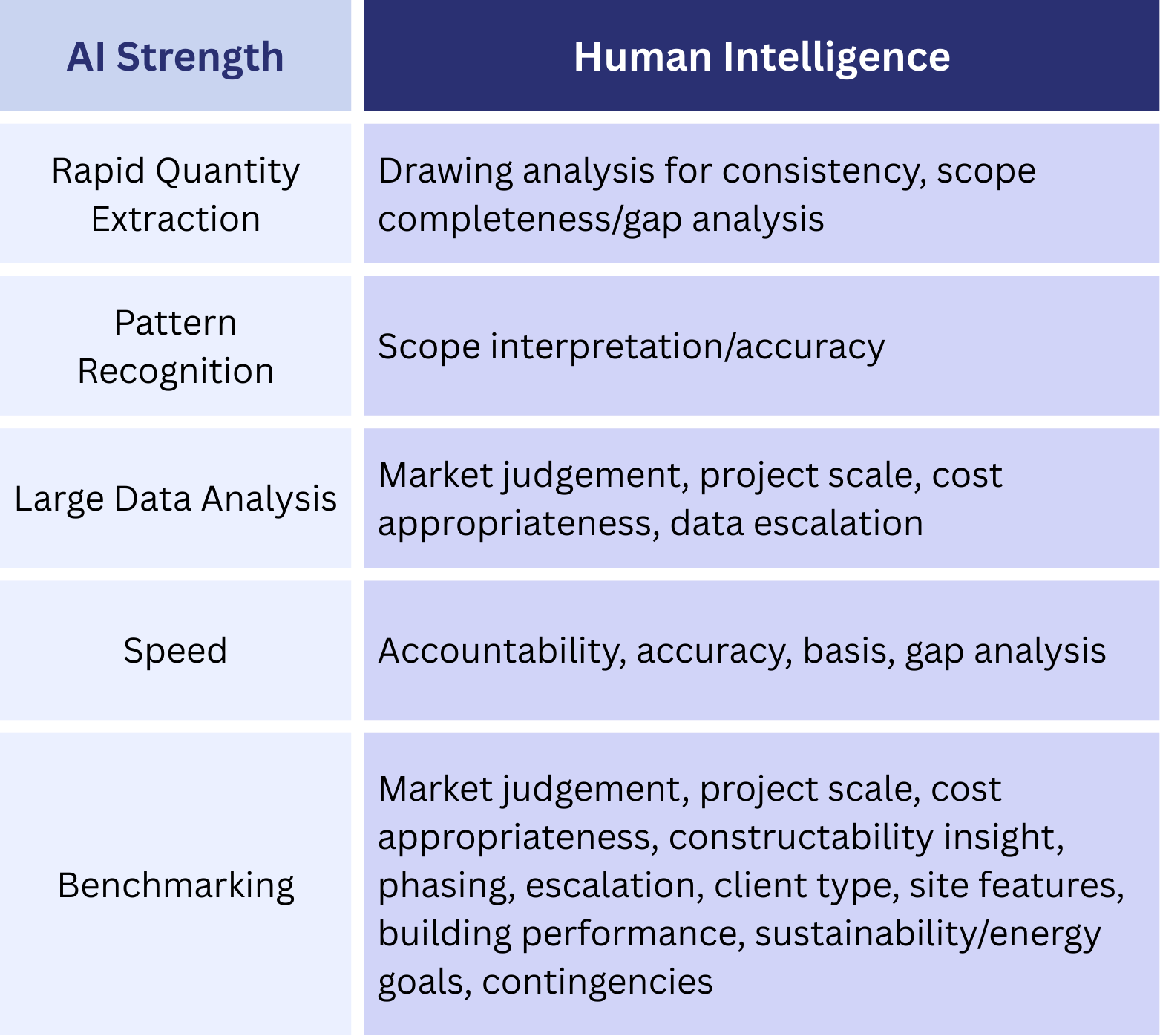
However, the conversation about AI should not be framed as people versus technology. It should be about how technology can strengthen the work of experienced professionals while preserving the accountability, transparency, and yes, judgement, that clients depend on.
Where Can AI Help?
AI is already proving useful in tasks that are time-consuming, repetitive, or data-heavy. We are actively testing tools that scan drawings, obtain price quotes for materials, recognize objects, and extract quantities in a fraction of the time required by traditional workflows. What once took hours of researching, tracing and counting can increasingly be performed in minutes.
Compared with established platforms these systems promise dramatic gains in speed, and that matters. Faster quantity development allows estimators to spend more time where they add the most value: validating scope (and filling in gaps), identifying risk, evaluating options, and advising clients on cost-effective solutions.
Early-Phase Estimate Production and Benchmarking
Raw data is not the same as reliable data.
Yes, AI can sift through enormous amounts of historical and publicly available information to generate order-of-magnitude benchmarks for new construction, but understanding the sources of data available on the public domain, normalizing costs for location, market conditions, escalation, procurement strategy, schedule, building size and massing, phasing, program variances and site complexity remains a sophisticated exercise. Two buildings that look similar on paper can vary dramatically in cost once those factors are understood.
Renovation and Hidden Conditions
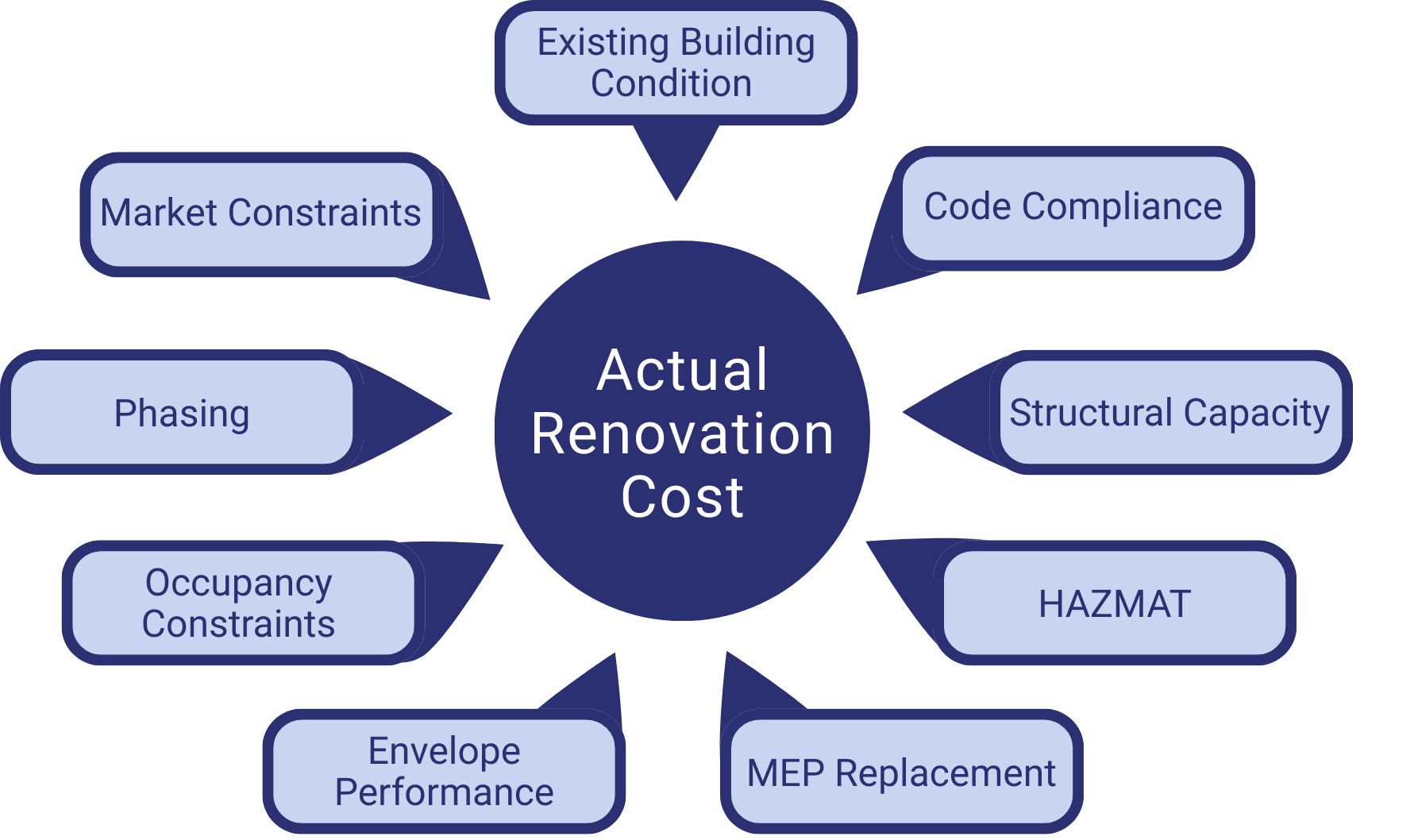
No two construction projects are ever identical, particularly when it comes to renovations. The level of intervention in the project is directly proportional to the eventual cost incurred, and so retrieving completed project data from AI-inspired means can be a dangerous approach. A finishes refresh is at one end of the range of completed cost of a project, while a full systems replacement with associated structural and envelope work might be at the other end. Creating a budget or cost plan without in-depth knowledge of the project at hand, combined with discipline specialists and their years of experience, can result in a wholly inappropriate budget for the proposed scope.
The Question Clients Always Ask
No matter how advanced the software becomes, one question always remains whether presenting a cost plan or reconciling it with a third-party estimate:
“Where did that number come from?”
If the estimator cannot explain the basis of a quantity or a unit price, the estimate loses credibility. Owners, designers, auditors, and funding authorities expect transparency. They want to understand the basis of cost, the assumptions behind it, and the level of confidence attached to it. An answer like “the algorithm produced it” is never sufficient.
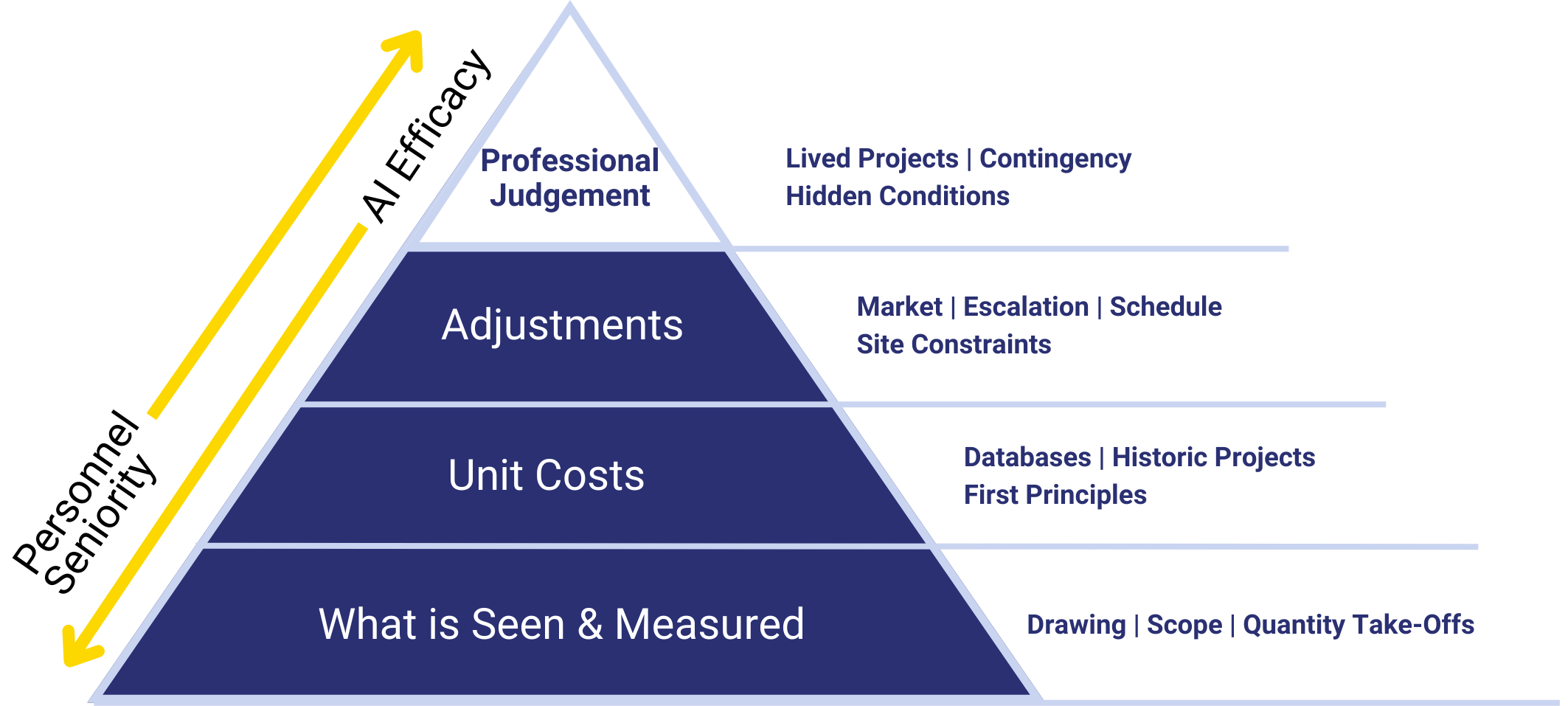
There is, however, promise in AI applied to an organization’s own historical data. When this data is combined with known project outcomes, documented assumptions, and verified production rates, AI can accelerate analysis while preserving the lineage and context of information. Data must be organized, reliable, appropriate, and accessible to realize the full benefits of AI. When the cost professional can still explain the source, the client can still trust the answer.
Standing Behind the Data
Ultimately, every estimate carries professional responsibility. Reputations are built on whether numbers hold up when procurement begins. Before relying on any AI-generated output, we believe estimators must ask:
Technology can assist in producing the answer, but it cannot own it.
Incorporating AI in Our Work
The future of cost estimating is not about replacing experts. It is about equipping them. AI can make us faster. It can help us see patterns. It can reduce manual effort. But the professionals who have lived hundreds of projects, walked job sites, reconciled change orders, debated scope with contractors, and assessed the impact of market fluctuations are the ones who turn information into advice.
That human experience is what allows an estimator to say, with confidence:
“Here is the number, here is why, and here is the range of risk at this stage”
And that is the standard clients deserve.